Plizio Visual Lab
The Unknown Slave
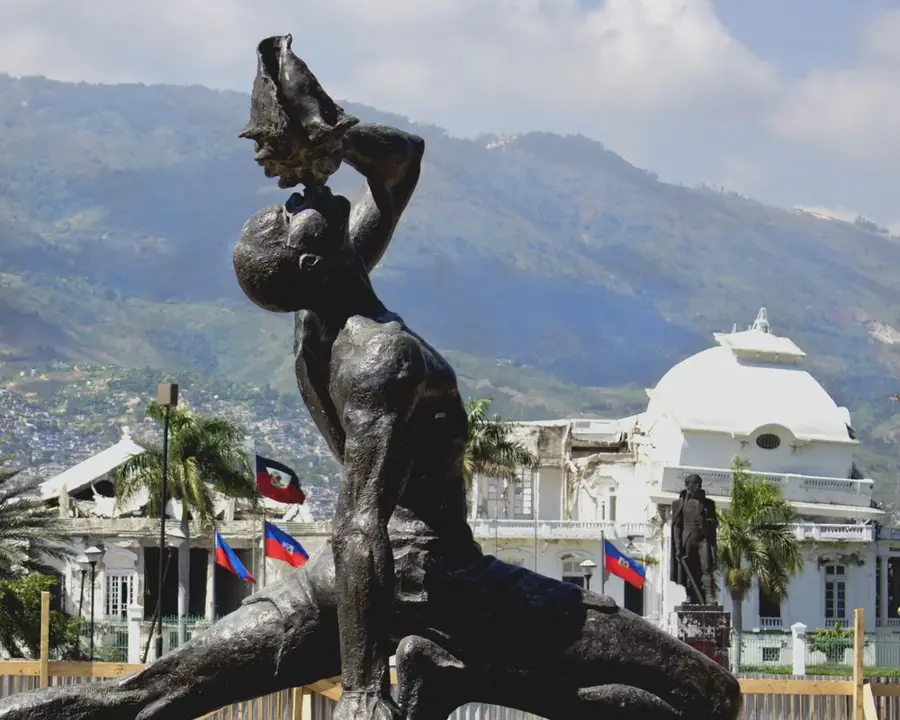
The monument 'Le Marron Inconnu' (The Unknown Slave or Maroon) is the most iconic symbol of Haitian freedom and is located in Port-au-Prince. The bronze statue was created in 1967 by the Haitian sculptor Albert Mangonès and depicts an enslaved man blowing a conch shell. This signal using the 'Lambi' shell was used during the colonial era to coordinate uprisings against the oppressors. The figure's powerful stance, with a shackle on the left leg and a machete in hand, embodies the indomitable will for self-liberation. The monument commemorates the slave revolt of 1791, which ultimately led to the founding of the Republic of Haiti. It stands opposite the National Palace and serves as a central gathering point for national ceremonies and demonstrations. The artwork is not only a monument to the past but also a symbol of the ongoing struggle for freedom and social justice. It is regarded as one of the most significant artistic testimonies of the Black liberation movement worldwide.
Explore on the map
How well do you know Haiti?
Find cities, landscapes and regions in 10 varied challenges on the interactive map.
Your journey, your memory
A postcard from The Unknown Slave
Turn your own photo into a personal postcard with a local stamp. Free and no sign-up required.
Create a postcard- Location: Haiti
- Highlights: Champ de Mars (Haiti) · Musée du Panthéon National Haïtien · Le Marron Inconnu
- Nearby: Furcy (15 km)
Best time to visit & climate
The most pleasant time to visit is Jan–Mar.
| Jan | Feb | Mar | Apr | May | Jun | Jul | Aug | Sep | Oct | Nov | Dec | |
|---|---|---|---|---|---|---|---|---|---|---|---|---|
| Avg °C | 26 | 26 | 26 | 27 | 28 | 28 | 29 | 29 | 29 | 28 | 27 | 26 |
| Rain mm | 19 | 16 | 25 | 37 | 62 | 41 | 38 | 64 | 49 | 75 | 56 | 28 |
📋 Practical info
Geography
Facts
- The monument was designed by architect Albert Mangonès in 1967.
- The statue is cast in bronze and rests on a solid concrete pedestal.
- The conch shell, or 'Lambi', was used by rebels as a means of communication.
- The figure holds a machete in his right hand, symbolizing both work and resistance.
- The monument is featured on the Haitian 50-centimes coin.
- It is located in the Champ de Mars near the National Palace of Haiti.
Explore nearby
Notable places around

Route planner — Car & Motorhome
Where do you start? We build the route here, with stops and country notes along the way.
© OpenStreetMap contributors · OpenRouteService
Sights in the town The Unknown Slave (3)
Sights nearby
Frequently asked questions
What does the statue symbolize?
Who created the monument?
Why is he holding a shell?
Where exactly in Port-au-Prince is it located?
Is it allowed to photograph the statue?
The Unknown Slave: where is it located?
The Unknown Slave: what is there to see?
The Unknown Slave: when is the best time to visit?
The Unknown Slave: why is it worth visiting?

Nearby cities


History & landmarks
Nature

More places