Plizio Visual Lab
Laacher See
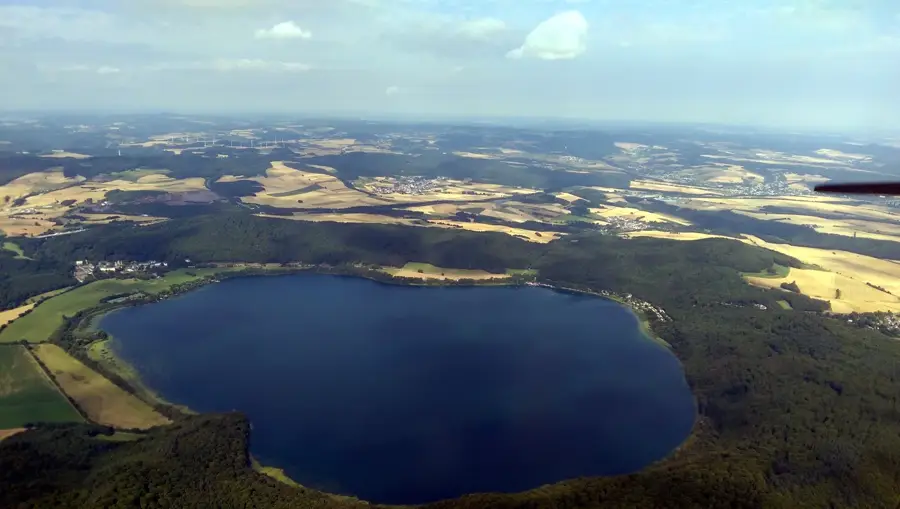
Laacher See is the largest lake in Rhineland-Palatinate and geologically represents a water-filled caldera, not a maar. It was formed by the massive eruption of the Laacher volcano approximately 12,900 years ago, which ranks among the strongest eruptions in Central Europe's recent geological history. The lake has a nearly circular shape and is surrounded by a ring wall of volcanic rock. On its eastern shore, mofettes, rising carbon dioxide bubbles, can still be observed today, proving that volcanism in the Eifel remains active. On the lakeshore stands the famous Benedictine Abbey of Maria Laach, an 11th-century masterpiece of Romanesque architecture. Today, the lake is a nature reserve of European significance and serves as a popular recreational area for hikers and water sports enthusiasts. Due to its depth of over 50 meters and its nutrient-poor waters, the lake supports specific flora and fauna. The scientific monitoring of seismic activities in the region is of great importance to geologists.
Explore on the map
How well do you know Germany?
Find cities, landscapes and regions in 10 varied challenges on the interactive map.
Your journey, your memory
A postcard from Laacher See
Turn your own photo into a personal postcard with a local stamp. Free and no sign-up required.
Create a postcard- Location: Rhineland-Palatinate, Germany
- Highlights: Bimsgrube · Thelenberg · Benediktinerabtei Maria Laach
- Nearby: Mayen (8 km)
Best time to visit & climate
The most pleasant time to visit is Jun–Aug.
| Jan | Feb | Mar | Apr | May | Jun | Jul | Aug | Sep | Oct | Nov | Dec | |
|---|---|---|---|---|---|---|---|---|---|---|---|---|
| Avg °C | 0 | 1 | 4 | 9 | 13 | 17 | 19 | 18 | 14 | 9 | 5 | 1 |
| Rain mm | 70 | 57 | 57 | 47 | 71 | 70 | 75 | 76 | 58 | 60 | 69 | 76 |
📋 Practical info
Geography
Facts
- Laacher See has a water surface area of approximately 3.3 square kilometers.
- The maximum depth of the lake is about 51 meters.
- The volcanic eruption 12,900 years ago ejected approximately 6 cubic kilometers of magma.
- Maria Laach Abbey on the lakeshore was founded in the year 1093.
- The CO2 bubbles (mofettes) on the eastern shore emerge underwater in some spots.
- The lake has no natural surface inflows and is primarily fed by groundwater.
Explore nearby
Notable places around
Route planner — Car & Motorhome
Where do you start? We build the route here, with stops and country notes along the way.
© OpenStreetMap contributors · OpenRouteService
Sights in the town Laacher See (10)
Aussichtspunkt Laacher See
Viewpoint overlooking Laacher See.
Steinerlebnispfad Station 1
Stone experience trail station 1, a water construction site.
Burgstall Burg Laach
Burgstall Burg Laach, a former castle site.
Laacher See
Laacher See, a nature reserve in Rhineland-Palatinate.
Laacher Kopf
Laacher Kopf, a mountain in Germany.
Krufter Ofen
Krufter Ofen, a mountain in Germany.
Sights nearby
Frequently asked questions
Is Laacher See a volcanic crater?
Is swimming allowed in Laacher See?
Which monastery is located directly by the lake?
What are the bubbles in the lake water?
How long does a hike around the lake take?
Laacher See: where is it located?
Laacher See: what is there to see?
Laacher See: when is the best time to visit?
Laacher See: why is it worth visiting?
Nearby cities