Plizio Visual Lab
Lübeck
ℹ️Practical info — Lübeck
▾
🌤 Weather — 5 days
📍 Nearby
Sights nearby
💡 Tips
- Visit the Holstentor early in the morning for the best light and fewer crowds.
- Take time to explore the hidden 'Gänge' (alleyways) and courtyards tucked behind the main streets in the old town.
- Park outside the Altstadt island and walk in; parking inside the historic center is expensive and scarce.
- Try a boat tour on the Trave river for a completely different perspective of the brick gothic architecture.
🍽 Food
Try the world-famous marzipan at Café Niederegger right in the city center.
Grab a fresh fish sandwich from the stalls along the Trave river promenade.
A traditional red wine matured in Lübeck, available in the city's historic wine cellars.
🛍 Shopping · 🧘 Quiet spots
A pleasant street filled with small, independent boutiques set inside historic gabled houses.
The main Niederegger shop gives the widest selection of marzipan creations, well-suited for souvenirs.
An idyllic riverside spot offering a first-rate postcard view of the old town skyline.
Take a nature walk along this quiet river, often referred to as the 'Amazon of the North'.
Water temperature…
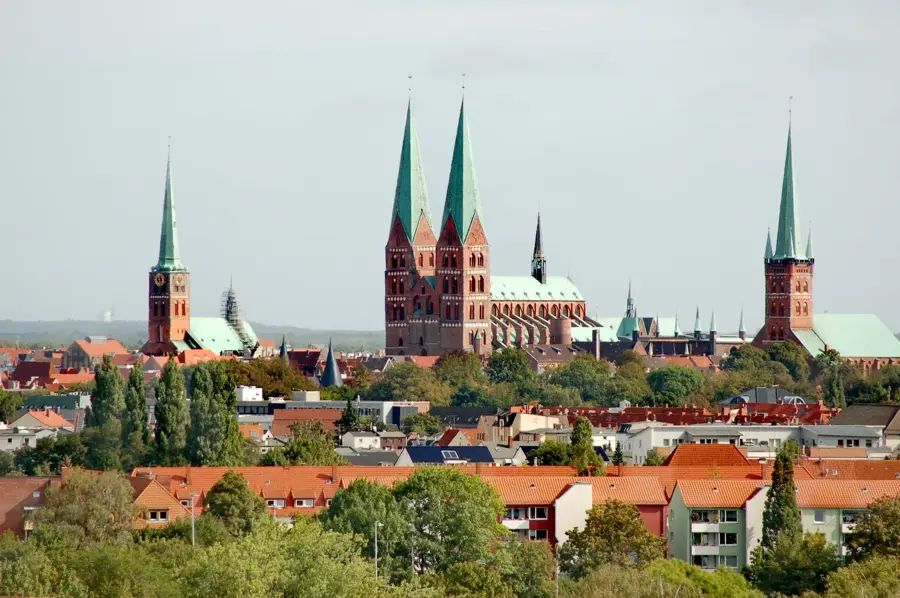
Lübeck, the former capital of the Hanseatic League, is located in northern Germany near the Baltic Sea and is celebrated for its cohesive medieval cityscape. Founded in 1143 by Adolf von Schauenburg, the city rapidly grew into the preeminent trading center of the Baltic region and attained the status of a Free Imperial City in 1226. The landmark of Lübeck is the Holsten Gate (Holstentor), a late Gothic city gate that now serves as a museum and symbolizes the city's historical economic power. The historic old town, situated on an island surrounded by the Trave River and canals, was designated a UNESCO World Heritage site in 1987 due to its significant Brick Gothic architecture. Lübeck's skyline is characterized by the seven spires of its five main churches, and the Lübeck Town Hall is considered one of the oldest and most beautiful in Germany. Culturally, the city is deeply connected to Nobel Prize laureates Thomas Mann and Günter Grass. Economically, the port continues to play a vital role as a link to Northern Europe, while the city remains world-famous as the birthplace of the renowned Lübeck marzipan.
Explore on the map
How well do you know Germany?
Find cities, landscapes and regions in 10 varied challenges on the interactive map.
Your journey, your memory
A postcard from Lübeck
Turn your own photo into a personal postcard with a local stamp. Free and no sign-up required.
Create a postcard- Location: Schleswig-Holstein, Germany
- Highlights: Holsten Gate · St. Mary's Church · Lübeck Town Hall
- Nearby: Bad Schwartau (6 km)
- Population: ~212.207
Best time to visit & climate
The most pleasant time to visit is Jun–Aug.
| Jan | Feb | Mar | Apr | May | Jun | Jul | Aug | Sep | Oct | Nov | Dec | |
|---|---|---|---|---|---|---|---|---|---|---|---|---|
| Avg °C | 1 | 1 | 4 | 8 | 12 | 16 | 18 | 18 | 14 | 10 | 5 | 2 |
| Rain mm | 63 | 51 | 47 | 37 | 54 | 67 | 77 | 71 | 55 | 60 | 58 | 66 |
Geography
Facts
- Lübeck was a Free Imperial City from 1226 and maintained this status until 1937.
- The Holsten Gate is one of the most famous German architectural monuments of the late Gothic era.
- St. Mary's Church features the world's highest brick vault, reaching nearly 40 meters.
- In 1987, Lübeck became the first city in Northern Europe to be named a UNESCO World Heritage site.
- The Buddenbrook House honors the writer Thomas Mann, who was born in the city in 1875.
- The city contains approximately 90 historic alleys and courtyards within the old town island.
Explore nearby
Notable places around
Route planner — Car & Motorhome
Where do you start? We build the route here, with stops and country notes along the way.
© OpenStreetMap contributors · OpenRouteService
Sights in the town Lübeck (22)
Frequently asked questions
What is the landmark of Lübeck?
Where can I try the authentic Lübeck marzipan?
Why is Lübeck called the 'Queen of the Hanseatic League'?
How far is Lübeck from the Baltic Sea beach?
Is the old town easy to explore on foot?
Lübeck: where is it located?
Lübeck: what is there to see?
Lübeck: when is the best time to visit?
Lübeck: why is it worth visiting?
Nearby cities