Plizio Visual Lab
Romanian National Opera, Cluj-Napoca
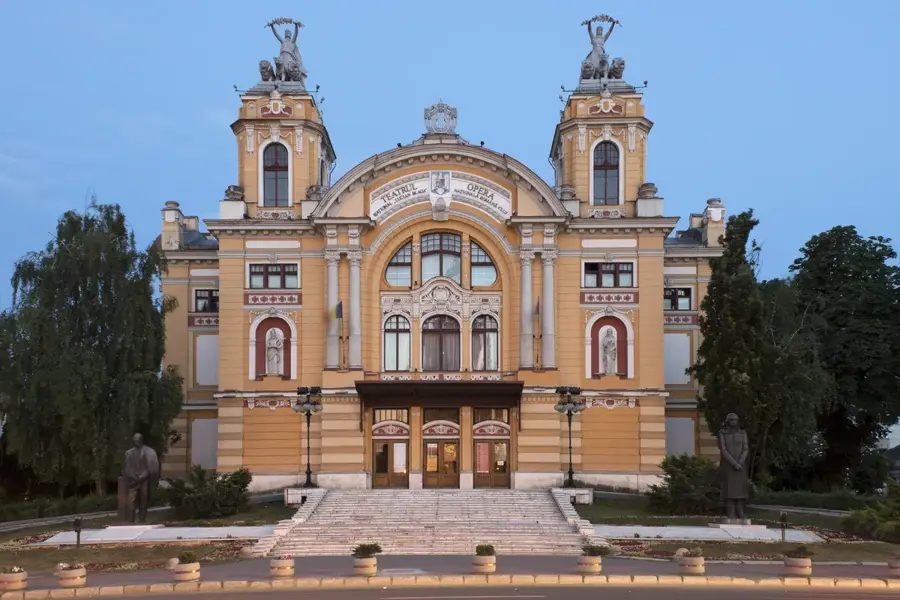
The Romanian National Opera in Cluj-Napoca is the first lyrical and dramatic institution established in Romania following the 1918 unification. It was officially founded on September 18, 1919, under the leadership of cultural figures like Tiberiu Brediceanu. The majestic building on Avram Iancu Square was constructed between 1904 and 1906 by the renowned Viennese architects Fellner & Helmer, known for designing grand theaters across Central Europe. Originally built as a Hungarian theater, it was transformed into the home of the Romanian Opera and National Theatre in 1919. The inaugural performance took place in May 1920 with Verdi's "Aida," marking a historic moment for the city's artistic life. The building features a Neobaroque architectural style with Secessionist influences and can accommodate over 900 spectators. Today, it stands as a cornerstone of Transylvanian culture, offering a diverse repertoire of world-class operas, operettas, and ballet performances.
Explore on the map
How well do you know Romania?
Find cities, landscapes and regions in 10 varied challenges on the interactive map.
Your journey, your memory
A postcard from Romanian National Opera, Cluj-Napoca
Turn your own photo into a personal postcard with a local stamp. Free and no sign-up required.
Create a postcard- Location: Cluj, Romania
- Highlights: Lucian Blaga National Theatre · Dormition of the Theotokos Orthodox Cathedral · Muzeul Mitropoliei Clujului
- Nearby: Baciu (6 km)
Best time to visit & climate
The most pleasant time to visit is Jun–Aug.
| Jan | Feb | Mar | Apr | May | Jun | Jul | Aug | Sep | Oct | Nov | Dec | |
|---|---|---|---|---|---|---|---|---|---|---|---|---|
| Avg °C | -3 | -1 | 4 | 10 | 15 | 19 | 22 | 22 | 16 | 10 | 4 | -1 |
| Rain mm | 35 | 34 | 43 | 51 | 81 | 97 | 90 | 63 | 53 | 53 | 41 | 40 |
📋 Practical info
Geography
Facts
- Officially established on September 18, 1919
- Building constructed between 1904 and 1906
- Designed by architects Fellner & Helmer
- First performance was Verdi's Aida in 1920
- The theater has a seating capacity of 928
- Neobaroque style with Secessionist elements
Explore nearby
Notable places around
Route planner — Car & Motorhome
Where do you start? We build the route here, with stops and country notes along the way.
© OpenStreetMap contributors · OpenRouteService
Sights in the town Romanian National Opera, Cluj-Napoca (10)
Muzeul Mitropoliei Clujului🏛 museum
Museum of the Metropolis of Cluj, displaying religious art and historical objects.
Barabás Miklós Guild
Arts centre named after painter Barabás Miklós, hosting exhibitions and workshops.
Institutul Francez din Cluj-Napoca
French cultural institute, offering language courses, library, and events.
Tailors' Bastion
Historic bastion in Cluj-Napoca, part of the former city walls, a heritage site.
Biserica Reformată de pe Ulița Lupilor
Reformed church in Cluj-Napoca, a heritage site in Cluj County.
Artexpert Gallery
Contemporary art gallery in Cluj-Napoca, with rotating exhibitions.
Transfiguration Greek-Catholic Cathedral
Greek-Catholic cathedral in Cluj-Napoca, dedicated to the Transfiguration of Christ.
Sights nearby
Frequently asked questions
Is there a dress code for performances?
Where can I buy tickets?
In what language is the singing?
Are there student discounts?
When was the opera house built?
Romanian National Opera, Cluj-Napoca: where is it located?
Romanian National Opera, Cluj-Napoca: what is there to see?
Romanian National Opera, Cluj-Napoca: when is the best time to visit?
Romanian National Opera, Cluj-Napoca: why is it worth visiting?

Nearby cities
History & landmarks
Nature
More places