Plizio Visual Lab
Battle of Batoche
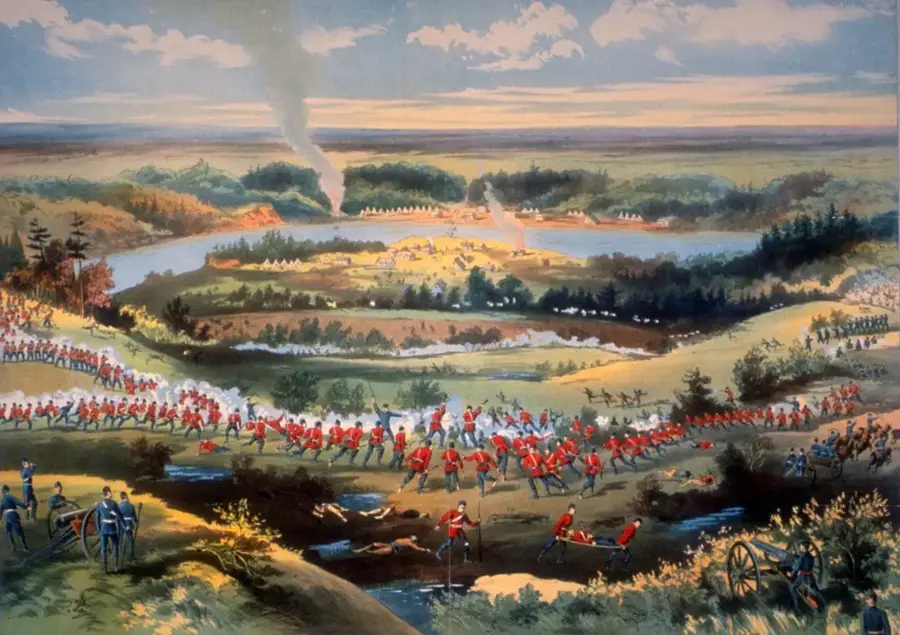
The Battle of Batoche, fought in May 1885, was the decisive confrontation of the North-West Resistance and a defining moment in the history of the Métis people and Western Canada. Located in present-day Saskatchewan, Batoche served as the capital of Louis Riel's Provisional Government of Saskatchewan. For four days, a small force of Métis and First Nations fighters led by Gabriel Dumont defended the settlement against a much larger and better-equipped Canadian government militia under General Frederick Middleton. The eventual fall of Batoche led to the surrender of Louis Riel and the end of the armed resistance against the expansion of the Canadian state into the West. Today, the Battle of Batoche National Historic Site preserves the remains of the Métis village, including the bullet-scarred church and rectory, and the intricate rifle pits used during the siege. The site is a profound symbol of Métis resilience, cultural identity, and the struggle for land rights and self-determination. It serves as a place of pilgrimage and education, highlighting the complex relationship between the Canadian government and the indigenous peoples of the prairies during the late 19th century.
Explore on the map
How well do you know Canada?
Find cities, landscapes and regions in 10 varied challenges on the interactive map.
Your journey, your memory
A postcard from Battle of Batoche
Turn your own photo into a personal postcard with a local stamp. Free and no sign-up required.
Create a postcard- Location: Canada
- Highlights: Letendre's former house · Musée du lieu national historique de Batoche · Duck Lake Regional Interpretive Center
- Nearby: Prince Albert (55 km)
Best time to visit & climate
The most pleasant time to visit is Jun–Aug.
| Jan | Feb | Mar | Apr | May | Jun | Jul | Aug | Sep | Oct | Nov | Dec | |
|---|---|---|---|---|---|---|---|---|---|---|---|---|
| Avg °C | -16 | -15 | -7 | 3 | 11 | 16 | 19 | 18 | 12 | 3 | -6 | -14 |
| Rain mm | 23 | 17 | 25 | 36 | 48 | 95 | 70 | 57 | 54 | 37 | 26 | 18 |
📋 Practical info
Geography
Facts
- The pivotal engagement occurred over four days from May 9 to 12, 1885.
- Métis forces numbered around 300 against over 800 government troops.
- Marked the first operational use of the Gatling gun in Canadian history.
- The defeat led directly to the capture and subsequent execution of Louis Riel.
- The St. Antoine de Padoue church still bears visible scars from rifle and cannon fire.
- Designated a National Historic Site in 1923, covering approximately 1,000 hectares.
Explore nearby
Notable places around
Route planner — Car & Motorhome
Where do you start? We build the route here, with stops and country notes along the way.
© OpenStreetMap contributors · OpenRouteService
Sights in the town Battle of Batoche (6)
Sights nearby
Frequently asked questions
What can you visit in Batoche?
What are the opening hours?
Are there guided tours?
How much does admission cost?
How do you reach the historic site?
Battle of Batoche: where is it located?
Battle of Batoche: what is there to see?
Battle of Batoche: when is the best time to visit?
Battle of Batoche: why is it worth visiting?

Nearby cities





History & landmarks

Nature
More places