Plizio Visual Lab
Spanish Fort Tobago

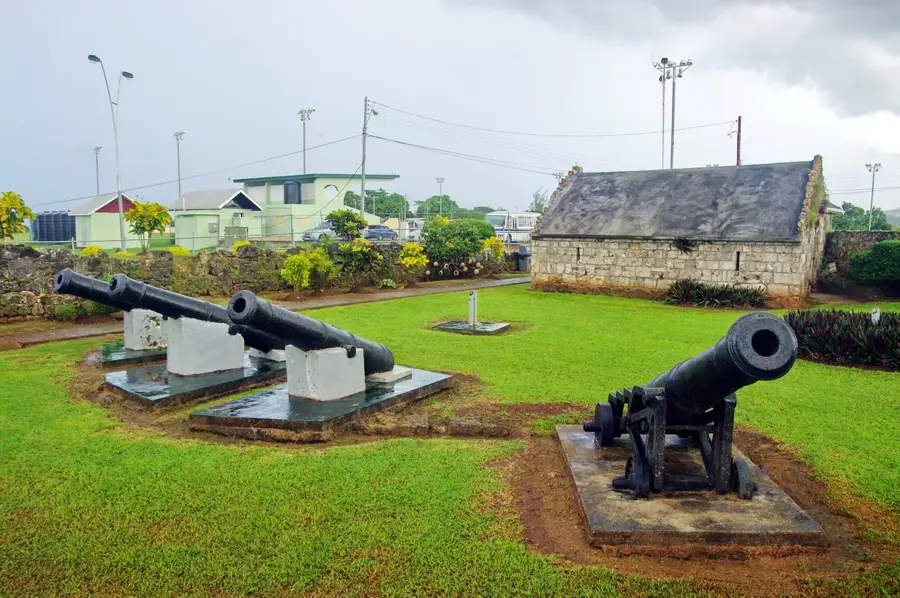
The Spanish Fort in Tobago refers to the early defensive positions established by Spanish forces during the 16th and 17th centuries. While Tobago is more famous for its British and French fortifications, Spain was the first European power to formally claim the island and attempt to fortify its strategic bays, particularly Great Courland Bay. These early forts were often modest outposts designed to deter rival European settlers and protect Spanish shipping routes between the mainland and the wider Antilles. The presence of Spanish military architecture, though now mostly in ruins or superseded by later structures, marks the beginning of Tobago's identity as a 'fortress island.' Historical accounts detail several skirmishes where Spanish garrisons defended these positions against Dutch and English expeditions. Today, the site gives a unique perspective on the earliest layers of colonial conflict in the Caribbean. It serves as an important archaeological link to the Spanish Empire's expansive but ultimately challenged influence in the Lesser Antilles.
Explore on the map
How well do you know Trinidad and Tobago?
Find cities, landscapes and regions in 10 varied challenges on the interactive map.
Your journey, your memory
A postcard from Spanish Fort Tobago
Turn your own photo into a personal postcard with a local stamp. Free and no sign-up required.
Create a postcard- Location: Trinidad and Tobago
- Highlights: Tobago Volcanic Group · Bacolet Formation · Mount Irvine Bay Golf Club
- Nearby: Canaan (4 km)
Best time to visit & climate
The most pleasant time to visit is Feb–Apr.
| Jan | Feb | Mar | Apr | May | Jun | Jul | Aug | Sep | Oct | Nov | Dec | |
|---|---|---|---|---|---|---|---|---|---|---|---|---|
| Avg °C | 27 | 26 | 27 | 27 | 28 | 28 | 28 | 28 | 28 | 28 | 28 | 27 |
| Rain mm | 83 | 49 | 39 | 44 | 86 | 157 | 166 | 168 | 132 | 169 | 193 | 145 |
📋 Practical info
Geography
Facts
- Spain formally claimed Tobago in 1498 following Christopher Columbus's third voyage.
- In 1637, a Spanish force from Trinidad successfully attacked and expelled Dutch settlers.
- Early Spanish maps referred to the island as 'La Magdalena' before 'Tobago' became standard.
- The fortifications were primary intended to prevent foreign bases near Spanish Trinidad.
- Archaeological evidence suggests Spanish presence was strongest in the mid-1600s.
- The site reflects the very first era of European military architecture in the region.
Explore nearby
Notable places around
Route planner — Car & Motorhome
Where do you start? We build the route here, with stops and country notes along the way.
© OpenStreetMap contributors · OpenRouteService
Sights in the town Spanish Fort Tobago (3)
Sights nearby
Frequently asked questions
Is admission free?
How long is the visit?
Can you climb the walls?
Is there parking?
When is the best time?
Spanish Fort Tobago: where is it located?
Spanish Fort Tobago: what is there to see?
Spanish Fort Tobago: when is the best time to visit?
Spanish Fort Tobago: why is it worth visiting?
Nearby cities

History & landmarks
More places