Plizio Visual Lab
Hudson Bay
Weather…
Water temperature…
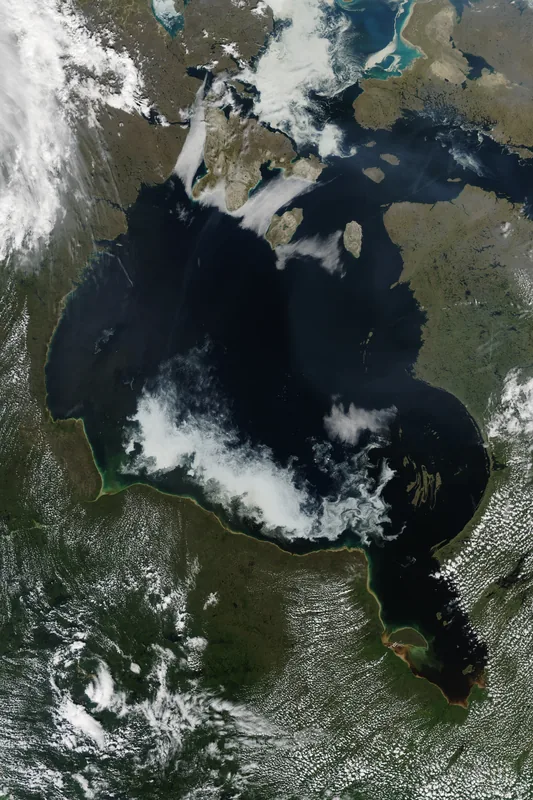
Hudson Bay is a vast inland sea in northeastern Canada and the second-largest bay in the world, following the Bay of Bengal. Covering approximately 1.23 million square kilometers, it spans the provinces of Quebec, Ontario, Manitoba, and the territory of Nunavut. Geologically, the bay is an epicontinental sea that was depressed by the weight of ice sheets during the last glacial period and has since been undergoing slow isostatic rebound. Explorer Henry Hudson reached the bay in 1610 while searching for the Northwest Passage, an expedition that later led to the founding of the Hudson's Bay Company in 1670. The waters are characterized by an extreme Arctic and subarctic climate and remain frozen for a large portion of the year. The region is an ecological hotspot, renowned for its significant populations of polar bears and beluga whales, as well as numerous seabird colonies. The coastal areas are often flat and marshy, dominated by boreal tundra and permafrost soils. Today, Hudson Bay serves as a critical location for climate change research, as declining sea ice levels have a direct and measurable impact on the local ecosystem's stability.
Explore on the map
How well do you know Canada?
Find cities, landscapes and regions in 10 varied challenges on the interactive map.
Your journey, your memory
A postcard from Hudson Bay
Turn your own photo into a personal postcard with a local stamp. Free and no sign-up required.
Create a postcardBest time to visit & climate
The most pleasant time to visit is Jul–Sep.
| Jan | Feb | Mar | Apr | May | Jun | Jul | Aug | Sep | Oct | Nov | Dec | |
|---|---|---|---|---|---|---|---|---|---|---|---|---|
| Avg °C | -21 | -22 | -18 | -11 | -4 | 0 | 4 | 8 | 5 | 2 | -3 | -15 |
| Rain mm | 17 | 14 | 25 | 28 | 41 | 59 | 65 | 75 | 75 | 73 | 52 | 28 |
📋 Practical info
Geography
Facts
- Hudson Bay covers a surface area of about 1.23 million km².
- The average depth of the water is only 100 meters.
- The water is significantly less saline than that of the open ocean.
- It was named after Henry Hudson, who was cast adrift here in 1611.
- The region supports one of the world's largest beluga populations.
- Sea ice typically begins to form in the bay during November.
Route planner — Car & Motorhome
Where do you start? We build the route here, with stops and country notes along the way.
© OpenStreetMap contributors · OpenRouteService
Sights in the town Hudson Bay (1)
Sights nearby
Frequently asked questions
Where is Hudson Bay located?
Can you see polar bears?
Is the water salty?
When does the bay freeze over?
Are there whale watching tours?
Hudson Bay: where is it located?
Hudson Bay: when is the best time to visit?
Hudson Bay: why is it worth visiting?
Nearby cities


History & landmarks



Nature
More places