Plizio Visual Lab
Ahmedabad Textile Industry

Ahmedabad, the largest city in Gujarat, has been celebrated as the 'Manchester of the East' since the 19th century and remains a dominant force in India's textile sector. The city's industrial journey began with the establishment of its first cotton mill in 1861, sparking a manufacturing boom that eventually intertwined with India's struggle for independence. Mahatma Gandhi made Ahmedabad his home, using the spinning wheel and hand-spun 'khadi' cloth as powerful symbols of economic self-reliance. Today, the industry has evolved into a high-tech sector, with Ahmedabad emerging as one of the world's largest producers of denim and diverse synthetic fabrics. Major players like Arvind Limited are headquartered here, catering to global fashion powerhouses. The city's growth was historically driven by the abundance of raw cotton in the Deccan region and the availability of water from the Sabarmati River. Home to the Ahmedabad Textile Industry's Research Association (ATIRA), the city continues to lead in textile innovation, combining traditional expertise with modern sustainability practices to maintain its global competitiveness.
Explore on the map
How well do you know India?
Find cities, landscapes and regions in 10 varied challenges on the interactive map.
Your journey, your memory
A postcard from Ahmedabad Textile Industry
Turn your own photo into a personal postcard with a local stamp. Free and no sign-up required.
Create a postcard- Location: India
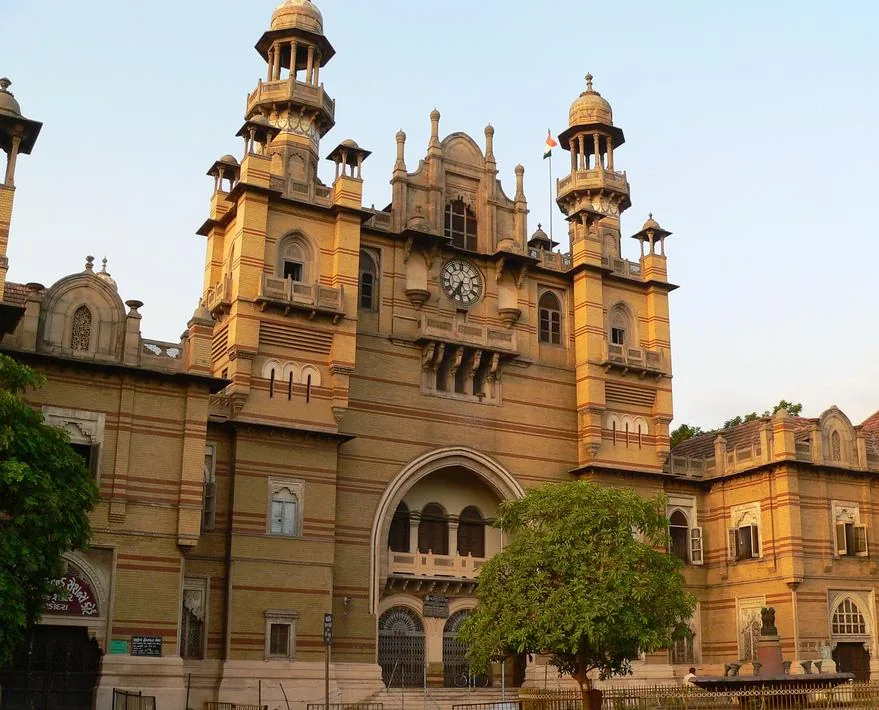
- Highlights: Sheth Mangaldas Girdhardas Memorial Hall · Sakar 4 · Sakar 2
Best time to visit & climate
The most pleasant time to visit is Jan, Feb, Dec.
| Jan | Feb | Mar | Apr | May | Jun | Jul | Aug | Sep | Oct | Nov | Dec | |
|---|---|---|---|---|---|---|---|---|---|---|---|---|
| Avg °C | 20 | 23 | 28 | 33 | 35 | 34 | 30 | 28 | 28 | 27 | 24 | 21 |
| Rain mm | 1 | 1 | 5 | 3 | 4 | 96 | 267 | 256 | 122 | 10 | 4 | 1 |
📋 Practical info
Geography
Facts
- The first textile mill was established by Ranchhodlal Chhotalal in 1861.
- Ahmedabad is one of the top denim producing centers in the world.
- The city houses over 60 major textile mills and thousands of MSME units.
- ATIRA was established in 1947 to spearhead research in the sector.
- The textile industry is a primary employer for hundreds of thousands in the region.
- By the early 20th century, the city operated over 80 active cotton mills.
Explore nearby
Notable places around
Route planner — Car & Motorhome
Where do you start? We build the route here, with stops and country notes along the way.
© OpenStreetMap contributors · OpenRouteService
Sights in the town Ahmedabad Textile Industry (10)
Villa Shodhan
Villa Shodhan is a modernist villa in Ahmedabad, designed by architect Le Corbusier.
Ahmed Shah Mosque
Ahmed Shah Mosque is a mosque in Ahmedabad, built in the 15th century.
Lokmanya Tilak Garden (Victoria Garden)🌳 park
Lokmanya Tilak Garden, also known as Victoria Garden, is a public park in Ahmedabad.
Ashram Building🏛 museum
Ashram Building in Ahmedabad is a museum dedicated to Gandhi's work.
Dargah
Dargah in Ahmedabad is a Muslim shrine, the tomb of a Sufi saint.
Kochrab Ashram🏛 museum
Kochrab Ashram was the first ashram organized by Mahatma Gandhi in India.
Sights nearby
Frequently asked questions
Why is Ahmedabad called the 'Manchester of the East'?
Are there any textile history museums in Ahmedabad?
Where can you buy locally made fabrics?
When is the best time for a shopping tour?
Are there factory tours available?
Ahmedabad Textile Industry: where is it located?
Ahmedabad Textile Industry: what is there to see?
Ahmedabad Textile Industry: when is the best time to visit?
Ahmedabad Textile Industry: why is it worth visiting?

Nearby cities

History & landmarks

Nature
More places