Plizio Visual Lab
Rotunda of Thessaloniki
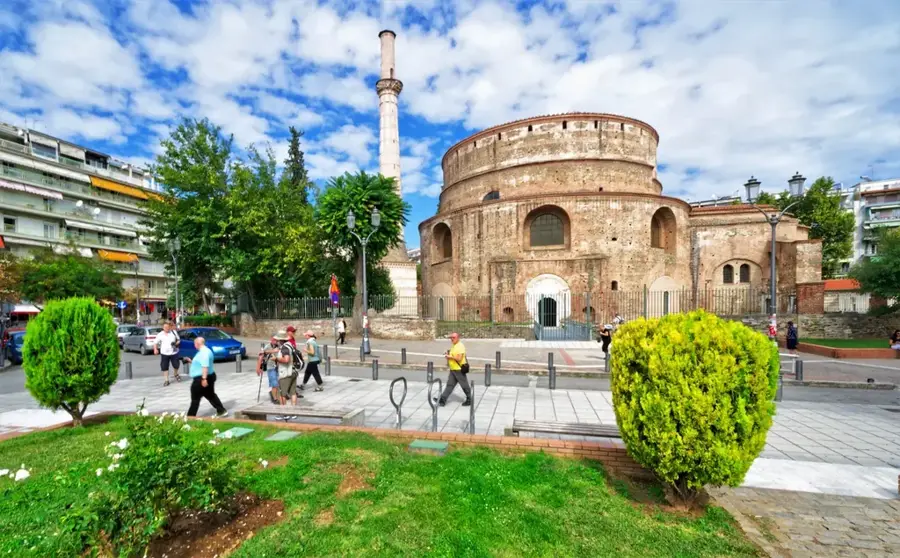
The Rotunda of Thessaloniki, also known as the Church of Saint George, is a massive circular structure built around 306 AD as part of the imperial palace complex of Emperor Galerius. Originally intended to be the emperor's mausoleum or a temple dedicated to Zeus or the Cabeiri, it is one of the oldest religious sites in Greece. The building features a magnificent dome with a diameter of 24.5 meters, which was once among the largest in the ancient world, supported by walls over 6 meters thick. In the late 4th century, Emperor Theodosius I converted it into a Christian church, adding exquisite gold-ground mosaics that are now celebrated as masterpieces of early Byzantine art. In 1591, during the Ottoman era, it was transformed into a mosque, and the minaret added then remains the only one standing in Thessaloniki today. Now a UNESCO World Heritage site, the Rotunda serves as a museum and stands as a symbol of the city's diverse cultural layers, having survived numerous earthquakes throughout the centuries.
Explore on the map
How well do you know Greece?
Find cities, landscapes and regions in 10 varied challenges on the interactive map.
Your journey, your memory
A postcard from Rotunda of Thessaloniki
Turn your own photo into a personal postcard with a local stamp. Free and no sign-up required.
Create a postcard- Location: Greece
- Highlights: Rotunda · Rotonda · St. George
- Nearby: Perea (15 km)
Best time to visit & climate
The most pleasant time to visit is May, Jun, Sep.
| Jan | Feb | Mar | Apr | May | Jun | Jul | Aug | Sep | Oct | Nov | Dec | |
|---|---|---|---|---|---|---|---|---|---|---|---|---|
| Avg °C | 5 | 6 | 9 | 13 | 19 | 24 | 27 | 27 | 22 | 16 | 11 | 6 |
| Rain mm | 47 | 38 | 48 | 40 | 46 | 38 | 29 | 24 | 47 | 51 | 44 | 64 |
📋 Practical info
Geography
Facts
- Built around 306 AD by Emperor Galerius.
- The dome spans 24.5 meters in diameter.
- The walls are over 6 meters (20 feet) thick.
- Converted to a church in the late 4th century.
- Became a mosque in 1591 under Ottoman rule.
- Designated a UNESCO World Heritage site in 1988.
Explore nearby
Notable places around
Route planner — Car & Motorhome
Where do you start? We build the route here, with stops and country notes along the way.
© OpenStreetMap contributors · OpenRouteService
Sights in the town Rotunda of Thessaloniki (8)
Arch of Galerius
Monument in Thessaloniki, Greece, a Roman triumphal arch from the 4th century.
Church of the Metamorphosis of the Sotir⛪ church
14th-century Byzantine chapel in Thessaloniki, Greece, dedicated to the Transfiguration of Christ.
Megaro Nedelkou🏛 museum
Nedelkos Mansion, a work of the noted architect Xenophon Paionidis (1909), residence of doctor Ioannis Nedelkos and later his son Konstantinos Nedelkos.
Panagouda Church⛪ church
Church building in Municipality of Thessaloniki, Central Macedonia, Greece.
Sights nearby
Frequently asked questions
What was the Rotunda originally built for?
Are there mosaics to be seen inside?
Why is there a minaret next to it?
Is it a church or a museum today?
What are the opening hours?
Rotunda of Thessaloniki: where is it located?
Rotunda of Thessaloniki: what is there to see?
Rotunda of Thessaloniki: when is the best time to visit?
Rotunda of Thessaloniki: why is it worth visiting?
Nearby cities