Plizio Visual Lab

Floralis Genérica
Plizio editorial teamData Sources
Landmark
—°13
Floralis Genérica (Argentina)

Weather…

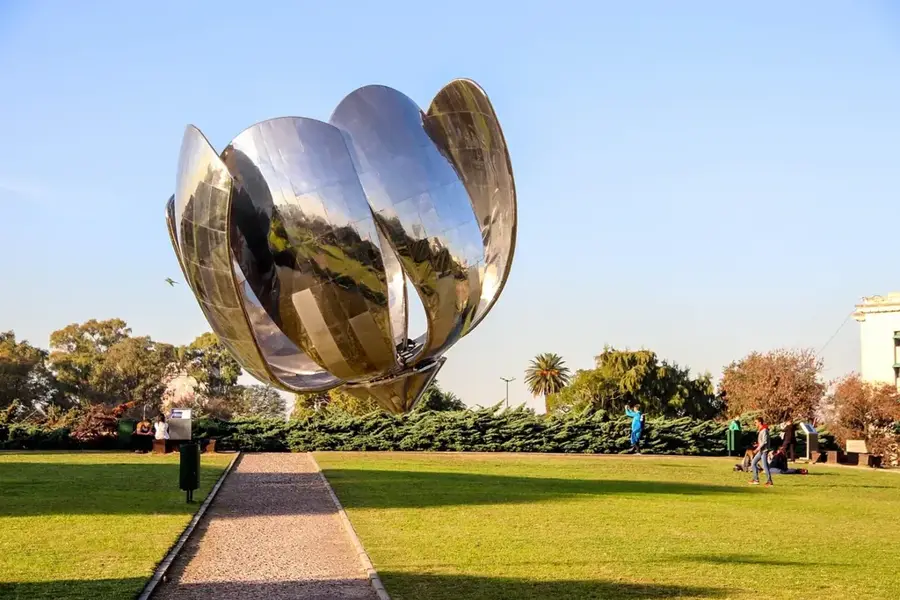
The Floralis Genérica is a monumental sculpture made of stainless steel and aluminum, located in the Plaza de las Naciones Unidas in the Recoleta district of Buenos Aires. Inaugurated in 2002, the artwork was created and donated to the city by the renowned Argentine architect Eduardo Catalano. The sculpture depicts a giant flower positioned over a reflective water pool. Its most distinctive feature is its kinetic mechanism: the petals are programmed to open at sunrise and close at sunset, mimicking the natural biological cycles of real flora. When fully expanded, the flower has a diameter of 32 meters and stands 23 meters tall, weighing approximately 18 tons. The sculpture is intended to symbolize hope and the constant renewal of life. Its polished metallic surface reflects the changing colors of the sky and the surrounding parkland, making it one of South America's most iconic and frequently photographed pieces of modern urban art.

Best time to visit & climate

The most pleasant time to visit is Mar, Nov, Dec.

JanFebMarAprMayJunJulAugSepOctNovDec
Avg °C25242117131091113172023
Rain mm110125122100724968698011310497

📋 Practical info

🚪
Visiting
The Floralis Genérica sculpture stands in the Plaza de las Naciones Unidas in Buenos Aires and is freely accessible at all times. You can view the artwork from outside, up close.
🕒
Typical hours
As a permanent installation, the sculpture is visible around the clock. The petals typically open in the morning and close in the evening, depending on daylight and wind.
📷
Photography
Photography is allowed without restrictions on the public square. The best time for photos is late afternoon when the sun illuminates the metal silhouette.
⏱️
Time needed
Viewing the sculpture itself takes about 15 to 20 minutes. If you enjoy the surrounding park and the view, allow around 30 to 45 minutes.
Combine with
The sculpture is in the upscale Palermo neighborhood, close to the Japanese Garden and Botanical Garden. Combine the visit with a walk through the green areas or to the MALBA Museum.
🧭
Getting there
The Plaza de las Naciones Unidas is on Avenida Figueroa Alcorta and easily accessible by bus or taxi. The nearest metro stations are Palermo (Line D) and Scalabrini Ortiz (Line D).
💡
Insider tip
Visit the sculpture early in the morning to observe the opening movement of the petals. A tripod is not necessary, but a polarizing filter can help reduce reflections on the metal.

Geography

Coordinates
-34.58300, -58.39340

Facts

  • The sculpture was officially inaugurated on April 13, 2002.
  • It weighs a total of 18 tons and is composed of six massive petals.
  • The flower opens every morning at 8:00 AM and closes at sunset.
  • The petals remain open all night on four specific dates: May 25, September 21, December 24, and December 31.
  • Eduardo Catalano spent several years developing the complex hydraulic system.
  • The sculpture is engineered to withstand wind speeds of up to 160 km/h.

Explore nearby

Notable places around
Route planner — Car & Motorhome

Where do you start? We build the route here, with stops and country notes along the way.

Vehicle
Only stops with (optional):

© OpenStreetMap contributors · OpenRouteService

Sights in the town Floralis Genérica (13)

Museo y Archivo Histórico de la Facultad de Derecho de la Universidad De Buenos Aires🏛 museum

This academic museum preserves the historical archives and legal heritage of the University of Buenos Aires.

Monumento a Bartolomé Mitre🏺 historical

This monumental sculptural tribute honors Bartolomé Mitre with an impressive statuary base.

Monumento a Rubén Darío🏺 historical

This sculptural public monument celebrates the influential Nicaraguan poet Rubén Darío.

Museo del Automóvil Club Argentino🏛 museum

This transport museum showcases a notable collection of classic cars and historic motoring artifacts.

🕒 Mo-Fr 10:00-17:30

Estatua de Poseidón🏺 historical

This classical-style stone statue depicts the Greek god of the sea holding his trident.

Plaza Rubén Darío🌳 park

Framed by grand avenues, this well-known park space provides shaded walkways and commemorative statues.

Plaza de las Naciones Unidas🌳 park

This prominent green space is famous for housing the giant kinetic flower sculpture, Floralis Genérica.

Centro de Exposiciones🎭 culture

This major exhibition center features expansive, flexible halls for hosting large-scale conventions.

National Library Mariano Moreno📍 landmark

A striking example of brutalist architecture, this monumental library stands on the site of a former presidential palace.

🕒 Mo-Fr 09:00-21:00; Sa-Su 12:00-19:00

Museo del Libro y de la Lengua Horacio González🏛 museum

Opened in 2011, this cultural institution explores the history of Argentine publishing and language.

🕒 Tu-Su 14:00-19:00🆓

Plaza Grand Bourg🌳 park

Modeled with elegant landscaping, this square often features floral displays reflecting its affluent neighborhood.

San Martín de Tours📍 landmark

This traditional Christian parish church stands out with its sober, unadorned architectural style.

Capilla Nuestra Señora del Huerto📍 landmark

A modest Christian chapel, it provides a quiet sanctuary with simple religious artwork.

Sights nearby

Frequently asked questions

What is Floralis Genérica?
It is a giant metal flower sculpture in Buenos Aires and one of the city's modern landmarks. Its petals open and close depending on the time of day.
When is the best time to see Floralis Genérica?
It looks best in the morning or late afternoon when the light is soft. If the mechanism is operating, that is a bonus.
How long do you need for a stop?
Usually 15 to 30 minutes is enough. With the park and photos, it can easily become a longer stroll.
Is it suitable for families?
Yes, the surrounding park makes the visit relaxed. Children have room to move as long as you watch the traffic.
Can you get good photos there?
Yes, especially with water, sky, and the white structure in the background. Soft light shows the shape best.
Floralis Genérica: where is it located?
Floralis Genérica is located in Argentina.
Floralis Genérica: what is there to see?
Highlights include Museo y Archivo Histórico de la Facultad de Derecho de la Universidad De Buenos Aires, Monumento a Bartolomé Mitre, Monumento a Rubén Darío.
Floralis Genérica: when is the best time to visit?
The most pleasant time to visit is Mar, Nov, Dec.
Floralis Genérica: why is it worth visiting?

The Floralis Genérica is a monumental sculpture made of stainless steel and aluminum, located in the Plaza de las Naciones Unidas in the Recoleta district of Buenos Aires.
View on map → The Top 50 Attractions → OpenStreetMap →
South America
Explore with Plizio Discover more places in South America
More places in Argentina →

History & landmarks

More places