Plizio Visual Lab
Mauna Kea
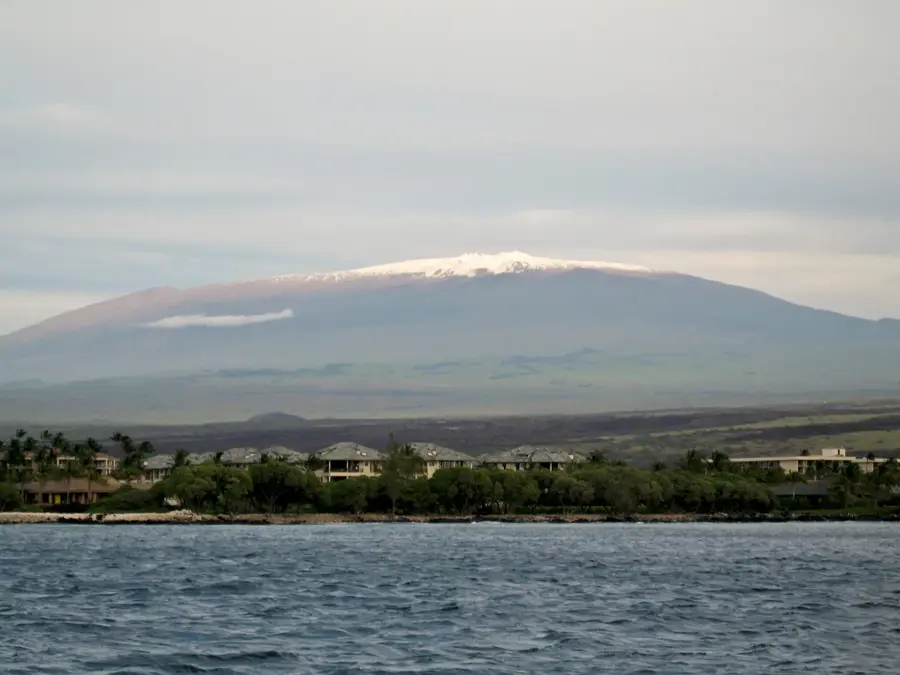
Mauna Kea, located on the massive Big Island of Hawaii, is a colossal dormant shield volcano and arguably the tallest mountain on Earth when measured precisely from its deep, massive oceanic base. While its summit reaches an impressive absolute elevation of 13,803 feet above sea level, its total height from the Pacific Ocean floor exceeds a staggering 33,500 feet, completely surpassing Mount Everest. The volcano's highly arid, extremely clear, and completely light-pollution-free summit provides arguably the most pristine conditions for optical and infrared astronomy on the entire planet. Consequently, it hosts a massive collection of the world's most powerful, technologically advanced astronomical observatories, operating under international cooperation.
Explore on the map
How well do you know United States?
Find cities, landscapes and regions in 10 varied challenges on the interactive map.
Your journey, your memory
A postcard from Mauna Kea
Turn your own photo into a personal postcard with a local stamp. Free and no sign-up required.
Create a postcard- Location: United States
- Highlights: Puʻukalepeamoa · Puʻuhaiwahine · Puʻukoʻohi
- Nearby: Hilo (42 km)
Best time to visit & climate
The most pleasant time to visit is May–Jul.
| Jan | Feb | Mar | Apr | May | Jun | Jul | Aug | Sep | Oct | Nov | Dec | |
|---|---|---|---|---|---|---|---|---|---|---|---|---|
| Avg °C | 20 | 19 | 20 | 20 | 21 | 21 | 22 | 22 | 22 | 22 | 21 | 20 |
| Rain mm | 124 | 143 | 189 | 165 | 122 | 92 | 110 | 125 | 106 | 129 | 153 | 151 |
📋 Practical info
Geography
Facts
- Reaches an absolute elevation of 13,803 feet above sea level.
- Measures over 33,500 feet from its massive underwater base.
- Technically the absolute tallest mountain on Earth base-to-peak.
- Hosts the largest, most formidable astronomical observatory globally.
- Considered deeply sacred in traditional Native Hawaiian culture.
- A massive, classic example of a powerful oceanic shield volcano.
Explore nearby
Notable places around

Route planner — Car & Motorhome
Where do you start? We build the route here, with stops and country notes along the way.
© OpenStreetMap contributors · OpenRouteService
Sights in the town Mauna Kea (4)
Sights nearby
Frequently asked questions
How high is the summit?
Can I drive to the very top?
Do I need time to acclimatize?
Does it really snow in Hawaii?
Is the place important for astronomers?
Mauna Kea: where is it located?
Mauna Kea: what is there to see?
Mauna Kea: when is the best time to visit?
Mauna Kea: why is it worth visiting?

Nearby cities