Plizio Visual Lab
Carnot
ℹ️Practical info — Carnot
▾
🌤 Weather — 5 days
📍 Nearby
Sights nearby
💡 Tips
- Cash is essential; ATMs are rare or unreliable, so bring sufficient CFA francs before arriving.
- Travel and exploration should strictly be done during daylight hours for safety and visibility.
- Always ask for permission before taking photographs, especially near markets, mining areas, or government buildings.
- Infrastructure can be very basic; carry a power bank and bottled water with you at all times.
🍽 Food
The staple carbohydrate, often served as a dense mash alongside hearty stews at local eateries.
Freshwater fish caught from nearby rivers, typically grilled over open fires and served with spicy sauces.
A rich, savory stew made with ground peanuts and meat, widely available in informal dining spots.
🛍 Shopping · 🧘 Quiet spots
The main hub for daily goods, where you can find colorful local fabrics and essential supplies.
Buy locally grown fruits and root vegetables directly from farmers early in the morning.
Walk down to the river edge away from the bustling center for a quiet view of the flowing water.
The immediate edges of the town offer calmer dirt paths, though always walk with a local guide.
Water temperature…
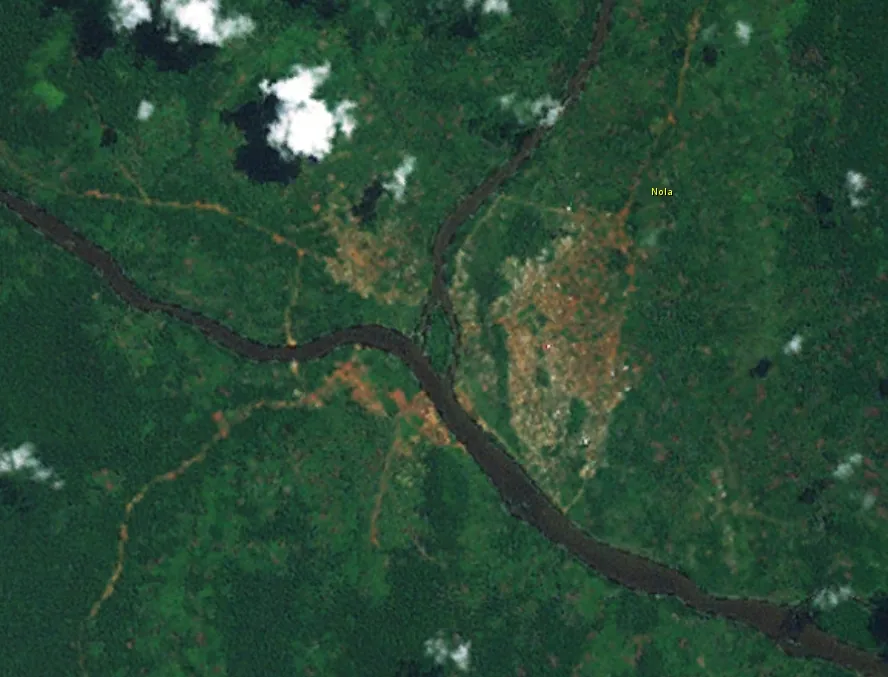
Carnot is a significant town located in the western part of the Central African Republic, within the Mambéré-Kadéï prefecture. Named in honor of the former French President Sadi Carnot, the town serves as a reminder of the region's colonial history. It is internationally renowned as a major center for the mining and trading of alluvial diamonds, making it a critical asset to the national economy. Geographically, Carnot sits on the banks of the Mambéré River, surrounded by a landscape of dense forests and savannas that support both mining and agriculture. While diamonds are the primary focus, the local population also engages in cultivating food crops and coffee. The town's strategic position on regional trade routes facilitates the movement of goods and people across the western hinterland. Despite facing various socio-economic challenges, Carnot remains a bustling multicultural hub due to the influx of laborers and merchants drawn by its natural resources.
Explore on the map
How well do you know Central African Republic?
Find cities, landscapes and regions in 10 varied challenges on the interactive map.
Your journey, your memory
A postcard from Carnot
Turn your own photo into a personal postcard with a local stamp. Free and no sign-up required.
Create a postcard- Location: Central African Republic
- Nearby: Gadzi (51 km)
- Population: ~129.032 (2026)
Best time to visit & climate
The most pleasant time to visit is Jan, Nov, Dec.
| Jan | Feb | Mar | Apr | May | Jun | Jul | Aug | Sep | Oct | Nov | Dec | |
|---|---|---|---|---|---|---|---|---|---|---|---|---|
| Avg °C | 25 | 27 | 27 | 26 | 26 | 25 | 24 | 23 | 24 | 24 | 24 | 24 |
| Rain mm | 6 | 33 | 115 | 118 | 150 | 163 | 232 | 213 | 248 | 216 | 56 | 10 |
Geography
Facts
- Carnot was named after the French statesman Marie François Sadi Carnot.
- The town is a global focal point for the alluvial diamond mining industry.
- It is situated on the Mambéré River in the western CAR.
- Carnot is served by a local airstrip with the ICAO code FEFC.
- The surrounding region is also active in coffee and timber production.
- The distance from Carnot to the capital, Bangui, is about 450 kilometers.
Explore nearby
Notable places around
Route planner — Car & Motorhome
Where do you start? We build the route here, with stops and country notes along the way.
© OpenStreetMap contributors · OpenRouteService
Sights in the town Carnot (1)
Frequently asked questions
Where does the city of Carnot get its name?
What is the economic focus of Carnot?
How are the road connections?
What religions are represented?
Are there nature attractions nearby?
Carnot: where is it located?
Carnot: when is the best time to visit?
Carnot: why is it worth visiting?